The cost of backyard interlocking in Ontario is $18 to $35 per square foot and is affected by stone brand, project size, labor rates, site preparation, and design complexity. A typical 300 square foot backyard patio costs between $5,400 and $9,000 installed. Premium stone brands and complex designs push costs toward the higher end.
Which factors affect the cost?
Several variables determine what you’ll pay for your backyard interlocking project.
- Stone brand and quality — This is the biggest price driver. Basic concrete pavers from brands like Oaks or Holland start around $4-5 per square foot for materials alone. Mid-range options like Permacon run $6-10 per square foot. Premium brands like Techo-Bloc and Unilock can cost $8-18 per square foot just for the stone.
- Project size — Larger patios cost less per square foot because setup costs get spread out. A 150 square foot patio might run $25-30 per square foot, while a 500 square foot patio could come in at $18-22 per square foot.
- Labor costs — Professional installation labor in Ontario ranges from $50 to $100 per hour per crew member in 2026. Most contractors charge $10-15 per square foot for labor, though this varies based on complexity.
- Site preparation — The ground needs excavation, grading, and a proper granular base 6 to 10 inches deep. Ontario’s freeze-thaw cycles demand solid foundation work. Poor drainage areas need additional work like French drains or catch basins, adding $1,500 to $4,000+.
- Backyard access — This matters more than most homeowners expect. A minimum 3-foot-wide access is needed for equipment. If materials and soil must be moved by hand through your house or a narrow gate, expect to pay $3 to $8 per square foot extra.
- Design complexity — Simple running bond patterns are standard. Circular patterns, fan designs, borders with contrasting colors, or multi-stone layouts require more cutting and fitting. This adds $3-5 per square foot.
- Removing old surfaces — Tearing out an old concrete pad costs $2 to $7 per square foot. For a 300 square foot patio, that’s $600 to $2,100 added to your project. Removing old pavers is usually cheaper.
- Special features — Fire pits, lighting, steps, seating walls, and drainage systems all increase the total cost. These are covered in detail below.
Patio Pavers. Price Per Sq Ft

BWS Standard Brick

BWS Ashford

Oaks Rialto

Unilock Beacon Hill

Blu 60 Polished Slabs
What are the different stone brands and their prices?
Ontario has several major brands available through landscape suppliers.
- Unilock — Canadian manufacturer with the widest range. Their basic Holland pavers start around $4 per square foot. Mid-range options like Granito run $8 per square foot. Premium lines like Beacon Hill Flagstone and Rivercrest cost $14-18 per square foot. Town Hall permeable pavers sit around $10-12 per square foot. Unilock uses EnduraColor technology on many lines for better color retention.
- Techo-Bloc — Premium Canadian brand known for modern finishes. Blu 80 (available in slate, smooth, polished, and galaxy finishes) runs $7.25-9.50 per square foot. Borealis slabs that mimic wood planks cost $12-16 per square foot. Industria pavers for contemporary looks run $10-14 per square foot. Techo-Bloc generally costs more than Unilock but offers unique modern aesthetics.
- Permacon — Solid mid-range option. Popular lines like Cassara run $9.81-11.37 per square foot. City slabs cost $12.52-17.28 per square foot. Melville and Mondrian lines are popular for patios and typically fall in the $8-12 per square foot range. Good quality without premium pricing.
- Oaks — More economical while maintaining decent quality. Centurion pavers cost around $5 per square foot. Rialto runs $7 per square foot. Colonnade products range from $6-9 per square foot depending on size and finish. Oaks products are precision-engineered and handle Ontario winters well.
- Best Way Stone — Ontario-based manufacturer specializing in porcelain and concrete pavers. Trevista 80 Smooth runs around $7 per square foot. Their porcelain GeoCeramica line costs $12-20 per square foot. Best Way offers Classic, Signature, and Premiere series with their DesignLoc technology.
- Belgard — Widely available with options at every price point. Heritage and Legacy collections offer traditional looks. Metropolitan collection provides modern options. Pricing varies widely from $5-15 per square foot depending on the product line.
Patio Projects & Prices
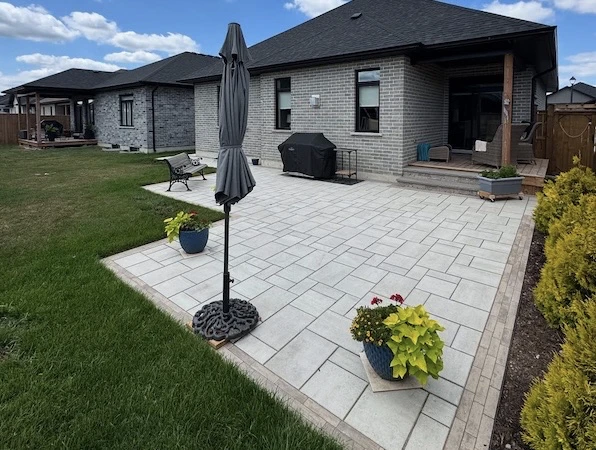
Backyard patio, slightly uneven shape with light border at Vaughan
- Area: 450 sq ft
- Date: July 2019
- Town: Vaughan
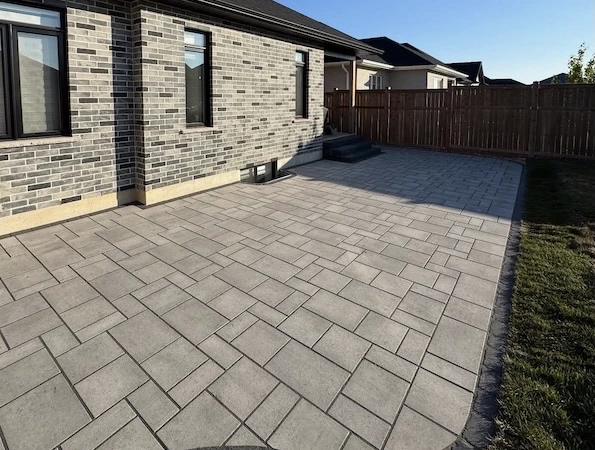
Standard patio with border in the backyard and stone steps at Oakville
- Area: 400 sq ft
- Date: May 2023
- Town: Oakville
How do different stone options compare?
Here’s how the main paver types stack up for quality, lifespan, maintenance, and price.
| Feature | Concrete Pavers | Clay Brick | Natural Stone | Porcelain |
|---|---|---|---|---|
| Material Cost (per sq ft) | $4-10 | $6-14 | $12-25 | $8-20 |
| Installed Cost (per sq ft) | $17-28 | $20-32 | $28-45 | $25-45 |
| Lifespan | 25-30 years | 30-50+ years | 50+ years | 30-50 years |
| Color Retention | Fair — can fade over time | Excellent — color through entire brick | Excellent — natural color | Excellent — nearly zero fading |
| Maintenance | Low — occasional polymeric sand refill, optional sealing every 3-5 years | Very low — no sealing needed | Low — may need sealing depending on stone type | Very low — nearly zero water absorption |
| Freeze-Thaw Resistance | Good with proper installation | Very good — tested for centuries | Varies by stone type (granite excellent, limestone good) | Excellent — extremely dense |
| Design Options | Many shapes, colors, textures available | Limited shapes, classic look | Unique natural look, each piece different | Modern finishes mimicking wood, concrete, stone |
- Concrete pavers are the most common choice. Brands like Unilock, Techo-Bloc, Permacon, and Belgard manufacture them in dozens of shapes and colors. The color goes through about half the thickness, so wear eventually shows the aggregate underneath.
- Clay brick offers traditional charm with color that goes all the way through. Chips and wear don’t show differently colored material underneath. Holds up extremely well to Ontario winters.
- Natural stone includes granite, limestone, sandstone, and flagstone. Each piece is unique. Limestone is popular in Ontario for patios due to its flat surface and warm tones. Costs significantly more but lasts longest.
- Porcelain pavers are newer to Ontario. Extremely dense and stain-resistant. Come in finishes that mimic wood, concrete, or stone. Require precise installation on a level base to avoid cracking. Nearly zero water absorption means no staining.

How long does installation take?
Timeline depends on project scope and weather.
| Project Type | Typical Duration |
|---|---|
| Small patio (100-200 sq ft) | 1-2 days |
| Medium patio (200-400 sq ft) | 2-3 days |
| Large patio (400-600 sq ft) | 3-5 days |
| Complex design with curves/patterns | Add 1-2 days |
| Patio with steps or seating walls | Add 1-3 days |
| Old patio/concrete removal required | Add 1-2 days |
| Fire pit or outdoor kitchen included | Add 2-4 days |
Most interlocking patio projects in the GTA are completed within 3-7 days, weather permitting. Rain stops work because the base needs to be compacted dry. Most contractors won’t install interlock between late November and early April due to frost.
Backyard access affects timeline significantly. A narrow gate with no side access takes longer than a yard where equipment can drive right in.
What do special features cost?
- Fire pits — A simple block fire pit kit runs $1,500 to $3,500 installed. A custom natural gas fire pit with proper gas line connection costs $3,000 to $6,000+. The gas line itself requires a licensed plumber and is charged separately.
- Outdoor kitchens — Built-in kitchens add $8,000 to $25,000 depending on size and features. A basic setup with a built-in BBQ and counter space sits at the lower end. Add a sink, fridge, and stone veneer and costs increase. Gas and electrical connections are extra.
- LED lighting — Recessed LED lights along patio edges or built into steps cost $150 to $300 per fixture installed, including wiring and transformer. A typical patio with 6-10 lights adds $1,000 to $2,500 to the project. In-ground paver lights cost $15 to $40 per fixture installed.
- Seating walls — Built-in seating using interlock block or natural stone costs $50 to $120 per linear foot depending on material and height. A 15-foot seating wall runs $750 to $1,800.
- Borders — A contrasting border using a different color or material is a popular upgrade. Soldier course borders add $3 to $8 per linear foot. Using premium accent pavers like natural stone borders around concrete pavers increases cost further.
- Steps — Paver steps cost $250 to $600 per step installed, depending on width and paver style. A standard 4-foot-wide set of 3-4 steps runs $1,500 to $3,500. Steps cost $50 to $150 per linear foot for the full width.
- Retaining walls — Sloped properties often need retaining walls alongside or around the patio. Costs range from $40 to $100 per linear foot for a standard 2-3 foot wall using interlock block. Taller walls requiring engineering cost significantly more.
- Water features — A small fountain or bubbler integrated into the patio costs $1,500 to $5,000+. Pondless waterfall features start around $5,000. Plumbing and electrical are extra.
- Sealing — Paver sealing protects against stains, enhances color, and stabilizes polymeric sand. Costs $1 to $3 per square foot. Should be done 60-90 days after installation and reapplied every 3-5 years. For a 300 square foot patio, that’s $300 to $900.
- Excavation for removal — Excavation costs add $200 to $350 per cubic yard depending on soil type and accessibility.
What are Ontario’s general construction requirements?
What are the allowed construction hours?
Ontario does not have a single province-wide rule for residential construction noise. Each municipality sets its own hours through noise bylaws. However, most follow a similar pattern:
- Monday to Friday: 7:00 AM to 7:00 PM
- Saturday: 9:00 AM to 7:00 PM
- Sunday and statutory holidays: No construction noise permitted
Some municipalities allow earlier Saturday starts (7:00 AM) while others restrict to 9:00 AM. Always check your specific city’s bylaw before work begins.
Do you need a permit?
In most Ontario municipalities, installing a ground-level interlock patio in your backyard does not require a building permit. Patios that sit at or near grade level are generally exempt.
You will likely need a permit if you are:
- Building a raised patio more than 24 inches (about 2 feet) above grade
- Adding a retaining wall over 1 metre (about 3.3 feet) in height
- Running gas lines for a fire pit or outdoor kitchen (gas permit required)
- Adding electrical work for lighting or kitchen appliances (electrical permit required)
Gas and electrical permits are separate from building permits and are handled by licensed trades.