Patio Renovation Cost in Ontario in 2026 | Price Calculator
The cost of patio renovation in Ontario ranges from $17 to $35 per square foot in 2026 and is affected by material choice, project size, site conditions, and design complexity. A typical 200-square-foot patio costs between $4,000 and $7,000, while larger 400-500 square foot patios run $8,000 to $15,000 installed. Natural stone and premium pavers push costs higher, while basic concrete pavers keep prices at the lower end of the range.
Which factors affect patio project price?
Several elements determine how much you’ll spend on your patio renovation.
- Material selection makes the biggest difference
- Project size directly impacts total cost
- Site conditions add expenses
- Base preparation matters for longevity
- Design complexity affects labor hours
- Stone selection and grading add costs for flagstone
- Demolition and removal of old surfaces adds $2 to $5 per square foot
Material selection makes the biggest difference. Concrete pavers cost $15 to $30 per square foot installed. Natural stone runs $18 to $35 per square foot. Flagstone specifically ranges from $18 to $35 per square foot installed, with premium types like bluestone pushing toward the higher end. Porcelain pavers sit at $20 to $40 per square foot. Plain poured concrete costs $8 to $15 per square foot, while stamped concrete ranges from $18 to $45 per square foot.
Project size directly impacts total cost. Contractors often charge less per square foot for larger projects. A 150-square-foot patio might cost more per square foot than a 400-square-foot space due to minimum project charges and equipment setup costs.
Site conditions add expenses. Poor drainage requires French drains or catch basins, adding $1,500 to $4,000. Difficult equipment access, sloped terrain, or rocky soil increase labor time. Excavation depth depends on soil conditions and existing grade.
Base preparation matters. Proper interlock installation needs 6 to 10 inches of compacted granular base. Poor soil or areas with drainage issues need deeper excavation and more stone, increasing costs.
Design complexity affects labor hours. Simple rectangular layouts cost less than curved edges, multiple borders, or intricate patterns. Herringbone and basket-weave patterns take more time to install than running bond. Flagstone naturally accommodates curves and organic shapes better than rectangular pavers, but the irregular pieces require more skilled labor and fitting time regardless of pattern.
Stone selection and grading add costs for flagstone projects. Irregular flagstone pieces need careful sorting and fitting. Premium-grade flagstone with consistent thickness and minimal flaws costs more than utility-grade stone. Expect to pay $3 to $8 more per square foot for select-grade flagstone that reduces installation time and produces cleaner results.
Demolition and removal of old surfaces adds $2 to $5 per square foot. Concrete removal costs more than old pavers or grass. Removing existing flagstone sits in the middle—easier than concrete demolition but heavier than concrete pavers. Some homeowners salvage old flagstone for reuse in garden borders or other projects, which can offset removal costs.
Patio Projects & Prices
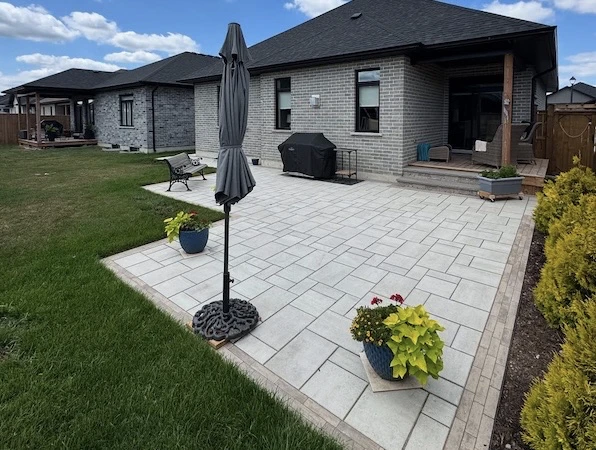
Backyard patio, slightly uneven shape with light border at Vaughan
- Area: 450 sq ft
- Date: July 2019
- Town: Vaughan
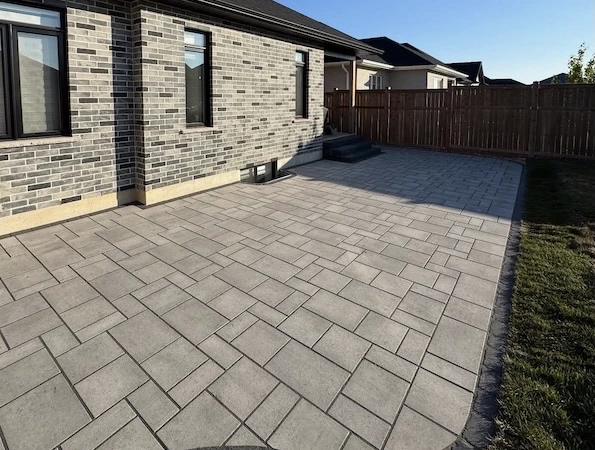
Standard patio with border in the backyard and stone steps at Oakville
- Area: 400 sq ft
- Date: May 2023
- Town: Oakville
What types of pavers work for Ontario patios?
Different paver materials suit different needs and budgets.
Concrete Pavers
Concrete pavers are the most common choice. They cost $15 to $30 per square foot installed. Basic styles run cheaper. Premium finishes and textured surfaces cost more. Concrete pavers last 20 to 30 years with proper maintenance. They handle Ontario freeze-thaw cycles well when properly installed.
Natural Stone Pavers
Natural stone pavers include flagstone, granite, limestone, and sandstone. Costs run $18 to $35 per square foot installed. Natural stone lasts 50+ years. Each piece is unique. Stone requires more installation precision than concrete. It costs more upfront but needs less maintenance over time.
Flagstone
Flagstone deserves special mention as Ontario’s most popular natural stone patio choice. Available in several types, each offers distinct characteristics. Sandstone flagstone comes in warm browns, golds, and grays with a slightly textured surface. Limestone flagstone provides softer tones but needs more frequent sealing in Ontario’s climate. Bluestone flagstone features rich blue-gray coloring and dense composition, making it the most durable—and expensive—option at the upper end of the price range.
Flagstone thickness varies from 1 to 3 inches, creating a rustic, organic appearance. Installation takes longer than uniform pavers because each irregular piece must be fitted like a puzzle. Most Ontario installers use dry-laid methods with polymeric sand rather than mortar. This allows the stone to flex with freeze-thaw ground movement without cracking. Mortar-set flagstone works better over concrete bases but costs more and requires skilled masonwork.
The natural slip-resistance of flagstone makes it safer than smooth concrete when wet. Its porous surface may show weathering variations over decades, which many homeowners appreciate as developing character rather than deterioration.
Porcelain Pavers
Porcelain pavers resist staining and scratching better than concrete. They cost $20 to $40 per square foot installed. Porcelain doesn’t fade and handles temperature changes well. Installation requires more precision than concrete pavers. Lifespan matches natural stone at 50+ years.
Clay Brick Pavers
Clay brick pavers provide timeless appearance. Materials cost $4 to $15 per square foot. Brick is eco-friendly and stain-resistant. Installation costs bring total price to $10 to $17 per square foot.

How does concrete compare to interlocking pavers?
Concrete and pavers each have distinct advantages.
Poured Concrete
Poured concrete costs less upfront. Plain concrete runs $8 to $15 per square foot. Stamped concrete costs $18 to $45 per square foot. A 350-square-foot plain concrete patio costs $2,800 to $5,250.
Concrete cracks over time. You can’t repair individual sections without visible patches. It shows wear from salt and freeze-thaw cycles. Most concrete lasts 15 to 25 years before needing replacement.
Interlocking Pavers
Interlocking pavers cost more initially but last longer. Basic concrete pavers run $15 to $30 per square foot installed. Flagstone and other natural stone pavers range from $18 to $35 per square foot. Individual damaged pavers lift out and replace without disturbing surrounding areas.
Pavers flex with ground movement without cracking. They handle Ontario winters better than solid concrete. Proper base preparation prevents settling. Pavers typically last 20 to 30 years for concrete versions and 50+ years for natural stone like flagstone.
Flagstone offers additional advantages over both concrete and concrete pavers. Its natural texture provides excellent slip resistance even when wet. Each stone piece is unique, creating one-of-a-kind patio designs impossible to replicate. While flagstone costs more upfront than concrete pavers, it requires less maintenance over its 50+ year lifespan. Sealing every 5 to 7 years keeps flagstone protected, versus concrete pavers needing resealing every 3 to 5 years.
Pavers offer better drainage through joints. This matters in Ontario where freeze-thaw cycles cause problems. Flagstone installed dry-laid with polymeric sand drains particularly well and handles ground movement from freeze-thaw better than mortared installations.
Patio Pavers. Price Per Sq Ft

BWS Standard Brick

BWS Ashford

Oaks Rialto

Unilock Beacon Hill

Blu 60 Polished Slabs
What special features add to patio cost?
Additional elements enhance your outdoor space but increase the budget.
- Outdoor lighting costs $150 to $300 per fixture installed
- Fire pits range from $500 to $5,000
- Pergolas cost $6,000 to $22,000
- Gazebos range from $2,000 to $10,000+
- Seating walls cost $40 to $80 per linear foot
- Steps and transitions cost $50 to $150 per linear foot
- Retaining walls cost $80 to $150 per linear foot
- Artificial grass costs $8 to $18 per square foot
- Water features range from $1,500 to $5,000+
Outdoor lighting costs $150 to $300 per fixture installed, including wiring and transformer. A typical patio with 6 to 10 lights adds $1,000 to $2,500. Low-voltage LED systems use less power and last longer.
Fire pits range from basic to custom. Simple paver fire pit kits cost $500 to $1,200 for materials and installation. Custom designs with seating walls run $2,000 to $5,000. Gas fire pits with underground lines add $1,500 to $3,000 for gas fitting and connection.
Pergolas provide overhead structure. Wood pergolas cost $6,000 to $16,000 installed. Aluminum pergolas run $10,000 to $22,000. Custom designs cost more than prefabricated units.
Gazebos create sheltered outdoor rooms. Installation costs range from $2,000 to $10,000 or more depending on size and materials.
Seating walls using the same pavers as your patio cost $40 to $80 per linear foot. Built-in planters add $200 to $600 per unit.
Steps and transitions connect different levels. Paver steps cost $50 to $150 per linear foot depending on materials and height. A standard 4-foot-wide set of 3 to 4 steps runs $1,500 to $3,500.
Retaining walls handle slope. Walls cost $80 to $150 per linear foot depending on height. Walls over 3 feet high may need engineering approval. A 15-foot-long, 3-foot-high retaining wall beside stairs costs $2,000 to $5,000.
Artificial grass around patio edges costs $8 to $18 per square foot installed. This eliminates mowing near hardscape edges.
Water features create ambiance. Small fountains or bubblers cost $1,500 to $5,000. Pondless waterfall features start around $5,000. All require plumbing and electrical work.
What paver brands are available in Ontario?
Ontario contractors work with several major paver manufacturers. Each brand offers different price points and quality levels.
Techo-Bloc
Techo-Bloc sits at the premium end. Materials run $8 to $18 per square foot. The Beacon Hill and Rivercrest lines are popular for patios. Techo-Bloc offers tight dimensional tolerances (1/16 inch) and extensive permeable paver options.
Unilock
Unilock provides wide selection across price ranges. Premium lines cost more but offer excellent color retention. Unilock pavers typically run $2 more per square foot than comparable brands. Their EnduraColor technology reduces fading.
Permacon
Permacon delivers solid mid-range options. The Melville and Mondrian lines work well for patios. Permacon pricing sits between entry-level and premium brands.
Oaks
Oaks provides affordable options. Precision-engineered pavers with good density factors.
Material costs for pavers range from $5 to $18 per square foot before installation labor.
How long does patio installation take?
Project timeline depends on size and complexity.
Small patios of 100 to 150 square feet take 2 to 4 days. This includes excavation, base preparation, paver installation, and cleanup.
Medium patios of 200 to 300 square feet need 4 to 7 days. Most homeowners install patios in this size range.
Large patios over 400 square feet require 7 to 14 days. Complex patterns, multiple levels, or extensive site work extend timelines.
Material type impacts installation time. Flagstone takes 30% to 50% longer than concrete pavers because each irregular piece must be individually fitted. A 300-square-foot concrete paver patio might take 5 days, while the same size in flagstone needs 7 to 8 days. This puzzle-like installation process requires skilled labor and patience.
Weather affects schedules. Rain delays compaction and installation. Ontario’s construction season runs May through October for best results. Flagstone installation particularly needs dry conditions since polymeric sand won’t set properly in damp weather.
Permit approval adds time before work starts. Simple projects might get approval in 1 to 2 weeks. Complex designs with grading changes take 4 to 6 weeks for review.
Site conditions affect timeline. Rocky soil slows excavation. Poor drainage requires additional preparation days. Difficult equipment access extends labor time.
What maintenance do patios need?
Different materials require different upkeep.
Concrete Pavers
Concrete pavers need polymeric sand replacement every 5 to 10 years. A 30-pound bag of polymeric sand costs $45 to $60. Professional cleaning and resealing costs $1 to $2 per square foot. This includes pressure washing, new polymeric sand, and sealer application.
Sealing protects pavers from stains and weather. High-end protective sealant costs $2 to $5 per square foot when applied 60 to 90 days after installation. Reseal every 3 to 5 years.
Natural Stone
Natural stone needs less frequent sealing. Softer stones like limestone flagstone need more attention than dense bluestone or granite. Sandstone flagstone sits in the middle—more durable than limestone but less dense than bluestone.
Flagstone Maintenance
Flagstone maintenance is straightforward. Seal flagstone 60 to 90 days after installation, then reseal every 5 to 7 years. Use penetrating sealers designed for natural stone rather than film-forming types that can trap moisture and cause spalling in freeze-thaw cycles. Professional sealing costs $2 to $4 per square foot.
Clean flagstone annually with pH-neutral stone cleaner and water. Avoid acidic cleaners that etch softer stones. Pressure washing works well but keep pressure under 1500 PSI to prevent surface damage. Remove weeds from joints promptly—they’re easier to pull when small. Polymeric sand in joints reduces weed growth compared to regular sand.
Address stains quickly. Oil stains need poultice treatment or degreaser designed for stone. Rust stains require specialized rust removers safe for natural stone. Most stains come out easily if treated within a few days.
Winter care matters for flagstone. Shovel snow with plastic rather than metal shovels to avoid scratching. Skip salt and calcium chloride—they can damage flagstone and cause efflorescence. Sand or kitty litter provides traction without chemical damage.
Concrete Patios
Concrete patios need resealing every 2 to 3 years. Cracks require professional repair. Surface restoration costs vary based on damage extent.
Basic maintenance for all patios includes sweeping debris, removing weeds from joints, and occasional pressure washing. Most homeowners handle this themselves.
General Ontario Requirements
All residential construction in Ontario follows provincial regulations for work hours and safety.
Construction work hours in residential areas typically allow work from 7:00 AM to 7:00 PM Monday through Friday. Saturday work usually runs 9:00 AM to 7:00 PM. Most municipalities prohibit construction noise on Sundays and statutory holidays.
These hours apply to all construction activities including excavation, equipment operation, material delivery, and installation work. Loading and unloading materials counts as construction activity under these bylaws.
Ontario Building Code sets minimum standards for all construction. While ground-level patios typically don’t require building permits, any structure attached to your home or elevated above grade may need approval.
Property line setbacks vary by municipality. Most require structures to sit at least 0.6 meters (about 2 feet) from property lines. Check local zoning bylaws before finalizing your patio location.
Drainage regulations require that your patio doesn’t direct water onto neighboring properties. Proper grading and drainage planning prevents problems with adjacent lots.
Utility locates are mandatory before any excavation. Ontario One Call provides free locates for public utilities. Private utility locates for pool lines or backyard services cost $200 to $500.
Municipal Patio Permit Requirements
Durham Region includes Ajax, Pickering, Whitby, Oshawa, Clarington, Brock, Scugog, and Uxbridge. Permit requirements vary by municipality within the region.
General Durham requirements focus on retaining walls over one meter high. Structural landscaping that changes water flow on your lot may need permits. Most ground-level patios using pavers or stone don’t require building permits.
Oshawa requirements state that decks more than 24 inches (60 cm) above finished grade need building permits. Ground-level patios typically don’t need permits. Site alteration permits may be required if your patio affects slope or sits within 0.6 meters of a property line.
Whitby, Ajax, and Pickering follow similar guidelines. Check with each municipal building department for specific requirements.
For Durham Region bylaw questions, contact your local municipality directly:
- Oshawa Building Services: 905-436-3311 or buildingservices@oshawa.ca
- Whitby Building Division: 905-430-4306
- Ajax Building Division: 905-619-2529
- Pickering Building Division: 905-420-4611
Oakville regulates patio construction through zoning bylaws and building code requirements.
Building permit requirements depend on your patio design. Ground-level patios using pavers or stone typically don’t need building permits. Elevated decks or structures require permits.
Zoning compliance is mandatory even when permits aren’t required. Your patio must meet setback requirements and lot coverage limits. Setbacks typically require structures to sit back from property lines and lot lines.
Before starting your project, verify your plans comply with Town of Oakville zoning by-laws. These regulate use, shape, and location of structures on properties.
Contact information:
- Town of Oakville Building Division: 905-845-6601 ext. 3955
- General inquiries: city@oakville.ca
Oakville’s building permit applications are available online through their municipal portal.
York Region includes Vaughan, Richmond Hill, Markham, Aurora, Newmarket, and other municipalities. Each has specific requirements.
Vaughan regulations state that most landscaping, including patio stones, doesn’t require permits. However, elevated decks and covered structures need building permits. Ground-level patios under 0.6 meters (about 24 inches) high and smaller than 18.6 square meters (about 200 square feet) typically don’t need permits if not attached to structures.
Contact: Vaughan Building Standards Department at 905-832-8510
Richmond Hill requirements follow Ontario Building Code standards. Building permits are needed for elevated decks. Ground-level patios using pavers typically don’t need permits. Zoning bylaws still apply to all projects.
Contact: Richmond Hill Building Division at 905-771-8800
Markham regulations require building permits for most construction projects. Before applying, confirm your project meets zoning bylaws and building code standards.
Contact: Markham Building Standards at 905-475-4870 or 905-475-4858
Newmarket bylaws may require building permits depending on your deck or patio design. Ground-level patio installations typically don’t need permits.
Contact: Newmarket Building Division at 905-895-5193
Aurora requirements follow similar patterns to other York Region municipalities. Check with the building department for your specific project.
York Region contact: Access York at 1-877-464-9675 for regional bylaw questions
All York Region municipalities require projects to meet local zoning bylaws even when building permits aren’t required.
These Halton Region municipalities have their own building permit processes.
Burlington requirements state that building permits must comply with Ontario Building Code and City zoning by-laws. Ground-level patios typically don’t require building permits. Elevated structures need approval.
Before any building, pool permit, or business license application, you need an approved Zoning Clearance Certificate from the City.
Contact information:
- Burlington Building Division: 905-335-7777
- Email: city@burlington.ca
- Bylaw enforcement: 905-335-7731 or bylaw@burlington.ca
Milton regulations require building permits for construction projects that alter structures or create new outdoor spaces above grade. Ground-level patio installations using pavers or stone typically fall below permit thresholds.
Milton offers online building permit applications through their municipal portal. Staff contacts applicants within two business days to discuss permit applications.
Contact information:
- Milton Building Department: 905-878-7252 ext. 2398
- TTY: 905-878-1657
- Fax: 905-876-5024
Both municipalities recommend contacting building departments early in your planning process to confirm requirements for your specific project.
Which paver brand offers best value?
Value depends on your priorities: upfront cost, longevity, or maintenance.
For lowest upfront cost, Oaks and Cambridge provide good quality at competitive prices. Materials run $5 to $10 per square foot. These work well for straightforward patio projects.
For best longevity, Techo-Bloc and Unilock lead the market. Their premium lines use advanced manufacturing processes. Dimensional tolerances are tighter, resulting in better long-term performance. Color retention exceeds economy brands.
For mid-range balance, Permacon and Belgard offer solid quality without premium pricing. Materials cost $6 to $12 per square foot. These brands provide good variety and reliable performance.
Natural stone delivers the longest lifespan at 50+ years. Upfront costs are higher but maintenance needs are lower. Stone doesn’t fade or deteriorate like concrete pavers might after 20 to 25 years.
Flagstone offers exceptional value when viewed long-term. At $18 to $35 per square foot installed, it costs more initially than concrete pavers but significantly outlasts them. A 300-square-foot flagstone patio costing $7,500 that lasts 50+ years works out to $150 per year. The same size in concrete pavers at $5,400 lasting 25 years costs $216 per year—and you’ll eventually face replacement costs. Flagstone’s lower maintenance requirements and timeless appearance add to its value proposition.
Porcelain pavers cost similar to premium concrete brands but outlast them. If your budget allows $20 to $40 per square foot, porcelain provides excellent long-term value.
Consider total lifetime cost, not just installation price. A cheaper paver that needs replacement in 15 years costs more than a premium option lasting 30+ years. Flagstone’s 50+ year lifespan makes it one of the most cost-effective choices over time despite higher upfront investment.
How does patio size affect per-square-foot pricing?
Larger patios typically cost less per square foot.
Small projects under 150 square feet often hit contractor minimum charges. Equipment setup, base material delivery, and site mobilization costs stay similar regardless of size. This pushes per-square-foot prices higher for small areas.
A 100-square-foot patio might cost $25 to $35 per square foot. The total project runs $2,500 to $3,500 but fixed costs make up larger portions.
Medium-sized patios of 200 to 400 square feet see better per-square-foot rates. Contractors spread fixed costs across more area. Pricing drops to $18 to $28 per square foot. A 300-square-foot patio costs $5,400 to $8,400.
Large patios over 500 square feet get the best per-square-foot pricing. Equipment and setup costs become smaller percentage of total. Bulk material purchases may get discounts. Pricing can drop to $15 to $22 per square foot. A 600-square-foot patio runs $9,000 to $13,200.
This pattern holds true across all material types. Natural stone, concrete pavers, and porcelain all see per-square-foot costs decrease as project size increases.
Frequently Asked Questions